UDC (Uniform Dwelling Code / One- and Two- Family Dwellings)
Program Code Chapter: SPS 320-325
Disclaimer: Review WI statute for full program requirements
Overview
The program governing one- and two-family dwelling units (including manufactured homes) is also called the UDC program, referring to the Uniform Dwelling Code. Enforces construction standards and inspection procedures including evaluation of building materials.
Soil Erosion
The UDC team also provides education and information concerning soil erosion control for construction sites involving one- and two-family dwellings. Find specific soil erosion program information throughout this UDC program page.
Permit and Plan Review
A permit under the UDC is required for new one- and two-family dwelling units. This includes stick-built, modular, and manufactured home installations.
Where Can I Get a Permit?
If the municipality covering your project location has been delegated authority to issue permits, and the project is not for a state-owned building or land, contact the municipality directly.
Use the UDC Delegated Agent List to determine if your municipality has authority to permit and inspect your project.
If your municipality does not have the proper authority, submit your application to DSPS via esla.wi.gov. See the eSLA Information page for getting started in eSLA.
What do I need to submit to DSPS?
Regardless of which agency has authority, your application must include:
Permit application. This may be electronic or paper, depending on the agency.
Contractor license numbers and expiration dates.
Legible building plans with scale or dimensions. Include:
Site and Erosion Control Plan
Floor Plan
Elevation detail (all four sides)
Required Data:
REScheck
Truss Plans
Water Calculation
Wall Bracing Worksheet
Permit application fee.
Inspection
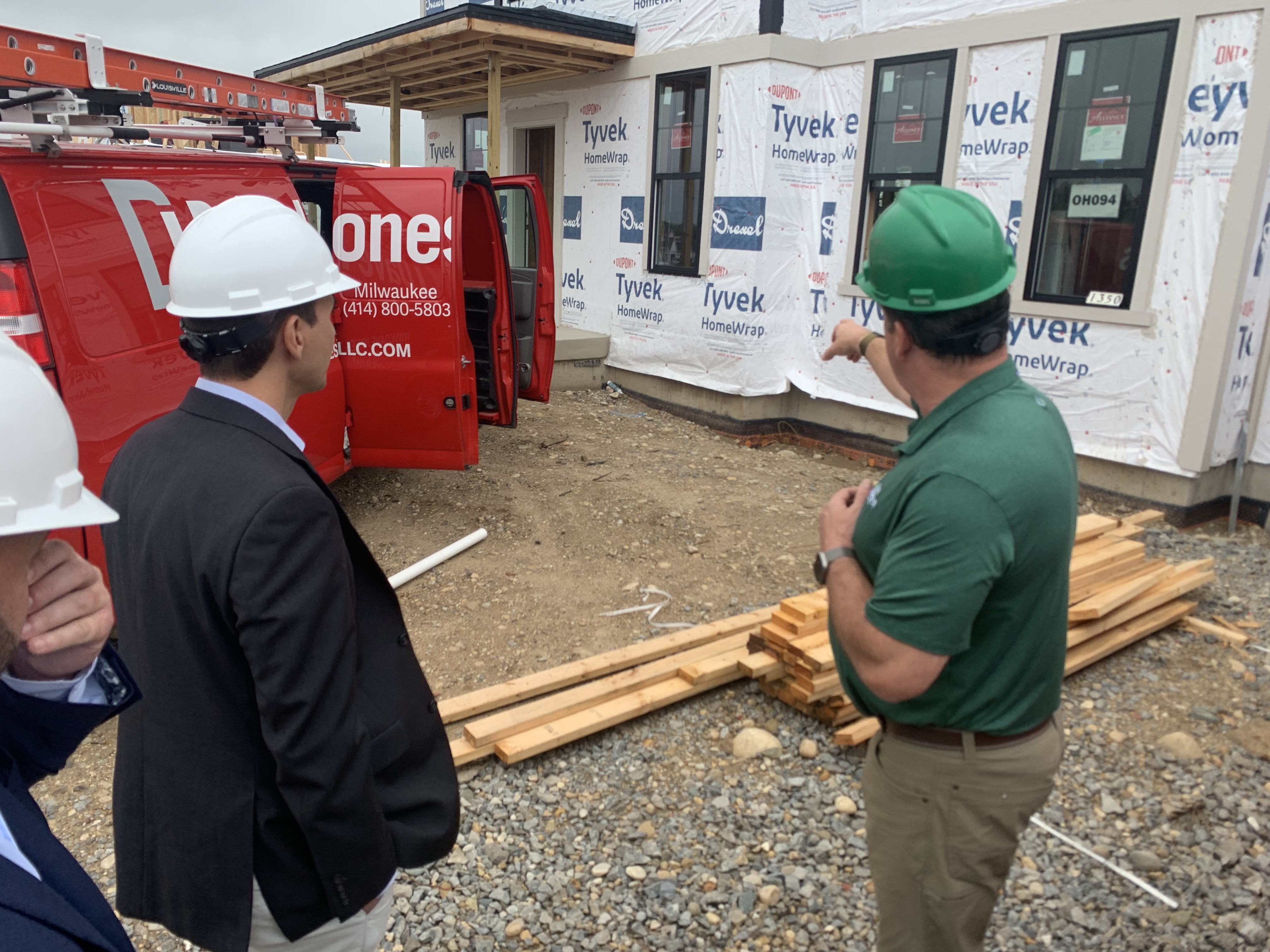
The following inspections are required on new one- and two-family dwellings. When ready for inspection, notify the inspector identified on your UDC permit.
Footings (includes excavation, etc.)
Foundation and foundation reinforcement
Rough (includes electrical, plumbing, HVAC, framing, etc.)
Insulation
Final
REScheck
REScheck is a software application that has been created by the Federal Department of Energy for demonstrating compliance with building envelope requirements of various State building codes.
Effective January 1, 2016, the Wisconsin Uniform Dwelling Code updated its energy conservation code to the 2009 International Energy Conservation Code. As before, compliance with the UDC can be shown by use of the federal REScheck program. However the newest software version available on the federal DOE website no longer has the option to calculate heating plant sizing. In order to continue to offer that service, use this older version of REScheck, build version 4.6.2.0. (This may be confirmed by looking at “About” under “Help” on the menu bar of the software. Note that you may have problems if you have more than one version of REScheck on your computer). If you use this version, you must first calculate building envelope compliance by selecting the “2009 IECC” under “Code” on the menu bar, even though you may see a warning that your location requires use of the “Wisconsin 2009” code. After printing that out and without exiting REScheck, you may switch your code to “Wisconsin 2009”, enter your county location and calculate your heating plant size on the Loads tab, as before.
Alternatively to size your heating plant by hand calculation after you have calculated building envelope compliance per the 2009 IECC, you would perform the following calculations, ignoring the units of measure:
Multiply the value in the “Your UA” field, from the Envelope tab of Rescheck, by the temperature difference for your dwelling location, which is 70 minus the value from the Outdoor Design Temperature of SPS 323.02(1) table and map in Appendix A of the UDC (link). (Note that subtracting a minus value is the same as adding.)
Calculate your conditioned building volume by multiplying your total conditioned floor area including basements in square feet by its average ceiling height in feet.
Select an air infiltration rate between 0.2 and 0.5 air changes per hour, based on your estimated dwelling envelope tightness.
Multiply the building volume value from step 2 by your selected air infiltration rate from step 3 and by your temperature difference and by the constant 0.018.
Add together the values from steps 1 and 4 to obtain your minimum heating plant output capacity, in BTU/hour. (Note that the UDC no longer has an over-sizing limit.)
Resources
Forms
Reference Material
Related Programs
Contact Us
If the municipality covering your project location has been delegated authority to issue permits and inspections, and the project is not for a state-owned building or land, contact the municipality directly.
Use the UDC Delegated Agent List to determine if your municipality has authority to inspect your project.
If the municipality does not have proper authority, use the Inspector Look-Up Tool to determine the DSPS-appointed inspector for your county.
Email DSPSSBUDCTech@wisconsin.gov.
DSPS maintains program-specific email inboxes (tech boxes) to answer general code questions. Responses should not be construed as formal code interpretations nor do they supersede any previously issued correspondence from DSPS. Tech boxes should not be used for projects where code officials are already involved.
Amusement Rides: DspsSbHealthAndSafetyTech@wisconsin.gov
Boilers and Pressure Vessels: DspsSbBoilertech@wisconsin.gov
Camping Units: DspsSbUdcTech@wisconsin.gov
Commercial Buildings and HVAC: DspsSbBuildingTech@wisconsin.gov
Electrical: DspsSbElectricTech@wisconsin.gov
Elevators: DspsSbElevatorTech@wisconsin.gov
Fire Prevention and Fire Departments: DSPSSBFirePrevention@wisconsin.gov
Fire Suppression and Fire Alarm Systems: DspsSbFireProTech@wisconsin.gov
Gas Systems: DspsSbBoilertech@wisconsin.gov
Manufactured Home Communities: DspsSbUdcTech@wisconsin.gov
Mines and Explosives: DSPSMineSafety@wisconsin.gov
Modular Dwellings: DspsSbUdcTech@wisconsin.gov
One- and Two-Family Dwellings: DspsSbUdcTech@wisconsin.gov
Plumbing and Cross Connection: DspsSbPlbgTech@wisconsin.gov
Private Onsite Wastewater Treatment (POWTS): DspsSbPowtsTech@wisconsin.gov
Product Evaluations (Building, Plumbing, Pools, POWTS): DspsSbProductTech@wisconsin.gov
Public Sector Safety: DspsSbHealthAndSafetyTech@wisconsin.gov
Public Swimming Pools: DspsSbPoolTech@wisconsin.gov
Refrigeration Systems: DspsSbBoilertech@wisconsin.gov
Ski Lifts and Tows: DspsSbHealthAndSafetyTech@wisconsin.gov
Welding (Structural): DspsSbBoilertech@wisconsin.gov
For general questions not related to specific programs or technical codes, use these contacts:
General permitting, plan submittal, invoicing, eSLA: eSLAsupport@wisconsin.gov
Materials Orders: DspsSbMaterialOrders@wisconsin.gov
Fire Safe Cigarettes: eslaSupport@wisconsin.gov
Fire Dues: DSPSSBFireDues@Wisconsin.gov
NERIS: DSPSISNERIS@wisconsin.gov
Delegated Agents: DSPSSBDelegations@wisconsin.gov
Grants: DSPSGrants@wisconsin.gov
Credential (licenses, certifications, registrations): https://license.wi.gov/s/file-a-complaint
Subscribe to email updates from DSPS and receive upcoming announcements and notifications.
Go to https://public.govdelivery.com/accounts/WIDSPS/subscriber/new
Enter your email address and click Submit.
Under Subscription Topics, expand the Industry Updates section.
Check all the topics of interest to you.
Scroll to the bottom and click Submit.
More Information
Related Pages
You may be interested in the pages below.
Codes and Statutes
Explore current and past codes and statutes for DSPS public safety programs.
Credentialing
Find DSPS credential information related to this program.