
2025 Dental Workforce Report
Partnering with the in 2025, the Wisconsin Department of Safety and Professional Services (DSPS) developed the 2025 Wisconsin DSPS Dental Workforce Report to better understand the current make-up of the dental workforce in Wisconsin and provide any insights into future trends/needs.
Prepared by the
Wisconsin Department of Safety and Professional Services (DSPS) and
the Marquette University School of Dentistry
From Wisconsin DSPS Secretary Dan Hereth

Access to healthcare and challenges within our healthcare workforce are among the most pressing concerns for government leaders and policymakers. Determining where care is available - and where it isn’t – and then predicting how that landscape is going to change in the near future are critical to our understanding and decision making around these issues.
That is why the Wisconsin Department of Safety and Professional Services (DSPS) has been strategically implementing workforce surveys at the point of license renewal. Our agency is uniquely positioned to do this work because we have access to 100% of Wisconsin’s licensed workforce. And as a state agency, we are part of broader statewide conversations and initiatives aimed at helping all Wisconsinites have access to the healthcare they need.
The data we collect is not for our benefit—it is for yours. Our data will be available to those working to ensure we have the healthcare workforce we need, when and where we need it. This includes other government agencies, like the Department of Health Services, which works to secure federal funding for underserved communities to expand access to care. This also includes educational partners, such as Marquette University, which conducted the analysis of our dental workforce survey data. Higher education institutions need to understand workforce needs as they make decisions about their programs and the pipeline to practice. Finally, this incudes policymakers, who can pass legislation addressing critical gaps in healthcare delivery.
I am also pleased to announce that after initial success with internal survey development and deployment for dental and medical renewals, we have identified a way to expand this work across more health professions in a more efficient and consistent way. We have adopted the Cross Profession Minimum Data Set (CPMDS), a standardized suite of survey tools, to expand data collection to new professions.
This past spring we used the CPMDS to collect data about our behavioral health workforce, and that data is currently being analyzed by the Center for Innovative Transition, Education & Employment at UW-Milwaukee. We will continue to apply the CPMDS to other survey efforts so we can offer state leaders current, reliable information about the Wisconsin healthcare workforce.
Work remains to ensure the sustainability of this effort. We need additional funding to ensure the broadest application of the CPMDS across as many health professions as possible and to ensure consistent and timely analysis of the data so it can inform policy and practice.
These efforts are a priority for our department as part of our larger Workforce Ready Wisconsin initiative, and we will continue to seek out partners to help us gather and analyze workforce data that is critical to the future of Wisconsin professionals, as well as their clients and patients.
Project Description

Knowledge is Power
DSPS plays an integral role in helping Wisconsin businesses and professionals better understand workforce challenges and address them. DSPS regularly interacts with the state’s licensed professionals and has taken the lead, under the administration of Governor Tony Evers, in strategically surveying the credentialed workforce at the point of license renewal. This work is part of the DSPS Workforce Ready Wisconsin initiative, using novel collaborations and data to speed the transition from classroom to jobsite and enhance Gov. Evers’ success in addressing our state’s workforce challenges.
Collaboration
While our Department is well-equipped to gather workforce data, we do not have the same in-house access to data analysis expertise and tools. For this, DSPS engaged with our partners at the Marquette University School of Dentistry (MUSOD). As Wisconsin’s only dental school, MUSOD shares our interest in workforce data related to the profession. They used their expertise to shape raw data into insights we believe many will find useful in understanding the current state of Dentistry in Wisconsin and the challenges the profession is facing.
A Word from Our Partner - Dr. Elsbeth Kalenderian
Dean and Professor, Marquette Univ. School of Dentistry

As the School of Dentistry for the State of Wisconsin, Marquette University School of Dentistry (MUSOD) has a national reputation for graduating highly skilled, caring dentists who give back to their communities. MUSOD serves as a nucleus for the state’s oral health care, providing care for over 30,000 patients at 110,000 annual patient visits, seeing citizens from 66 of Wisconsin's 72 counties.
In addition to outstanding patient care, MUSOD also serves a vital role in its partnership with DSPS in collecting data from dentists statewide to better understand the workforce. This information is necessary so policymakers, educators, employers and other stakeholders can make informed decisions that ensure that all people in Wisconsin have access to the oral health care that they need and deserve.
Understanding Wisconsin's Dental Workforce: Why this Matters
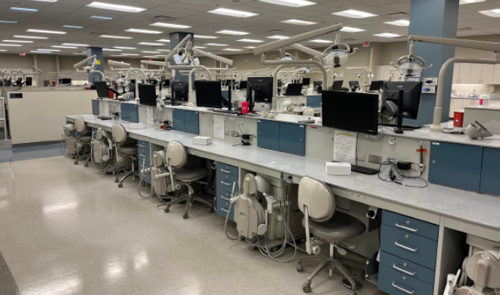
Marquette University School Dentistry Dental Lab
This workforce analysis was carried out using data from the Department of Safety and Professional Services. The purpose is to better understand the current make-up of the dental workforce in Wisconsin and provide any insights into future trends/needs. The overarching goal is to support the health and wellbeing of people across the state by providing information to those who shape the future of oral health in Wisconsin.
The results are meant to inform:
Policymakers, who make decisions about health policy and funding
Educators, who prepare the next generation of dental professionals
Industry leaders, who respond to workforce needs and help shape care delivery
Community and public health advocates, who work to ensure access to care in all parts of the state
The results can be a tool to help Wisconsin plan ahead, address gaps, and make sure that people in all regions of Wisconsin can access the oral health care they need.
Key Insights

The 2022–2024 survey gathered responses from over 5,500 dental professionals, including dentists and dental hygienists. The findings offer a detailed look at who is in the workforce, where they are located, and how things may change in the years ahead.
Positives
Strong participation: The high response rate shows that dental professionals are engaged and willing to contribute to statewide planning.
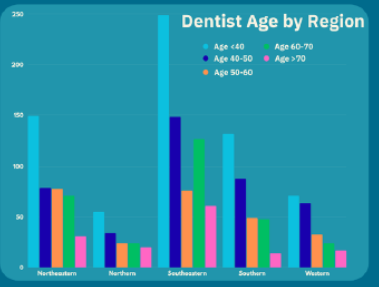
Younger dentists in urban areas: The Southeastern region, including Milwaukee, has the highest share of dentists under 40. This suggests a healthy pipeline of early-career providers in areas with high demand.
More Positives
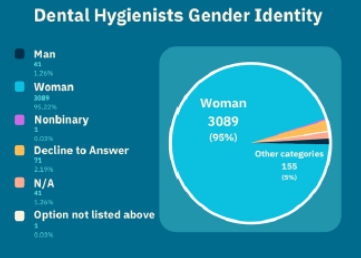
Women well-represented in dental hygiene: Over 95% of dental hygienists are women, showing strong participation in this part of the workforce.
Concerns
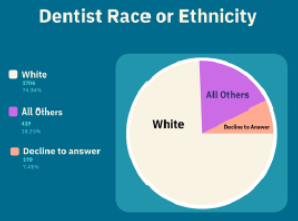
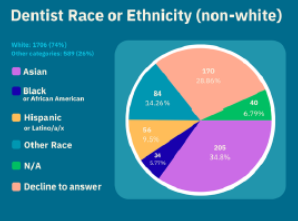
Lack of racial diversity: About 74% of dentists identify as White, while only 1.5% identify as Black or African American. These gaps are even wider in rural areas and among older age groups.
More Concerns
Uneven distribution: Younger dentists are mostly located in urban and southeastern parts of the state. Northern and rural regions have far fewer early-career providers, which could lead to access issues in the future.
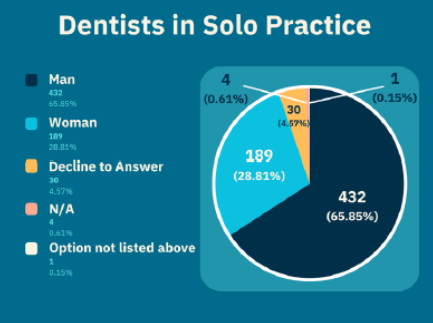
Gender imbalance in solo practice: Men make up more than twice the number of women among solo practitioners, pointing to possible barriers for women in practice ownership.
Implications for the Future
The following are some insights that can help in future planning:
Plan for retirements, which can impact the future oral health care workforce.
Support diversity in education and hiring (differences based on race and sex are pronounced)
Address regional shortages, which can improve access to oral health care
Ensure that oral health services are available and equitable across the state
Contact Us
Call Us:
(608) 266-2112
Email Us:
dsps@wi.gov
Mailing Address:
Dentistry Examining Board
DSPS
P.O. Box 8366
Madison, WI 53708-8366
Office Hours:
7:45 AM - 4:30 PM
Location:
Department of Safety and Professional Services
4822 Madison Yards Way
Madison, WI 53705
Dentistry Examining Board | Home