
Maintaining Your POWTS - Septic System
You would certainly never think of connecting the plumbing that carries wastewater from your house to the plumbing that carries fresh water to your drinking water tap. That's exactly what you might be doing. An improperly sited, overloaded or poorly maintained POWTS (Privately Owned Wastewater Treatment System) can add nutrients, bacteria, viruses and hazardous chemicals to groundwater. Those pollutants can then be drawn into your well and come out the tap in your drinking, cooking and bathing water.
Even if you don't pollute your own or your neighbor's drinking water, improperly functioning POWTS can add pollutants to lakes and streams increasing weed and algae growth and, in extreme cases, killing fish.
These problems can be avoided if POWTS is:
Correctly Sited
Properly Designed
Carefully Installed
Correctly Used
Regularly Maintained
Regular maintenance costs much less than repair or replacement of a failed system.
How Your System Works
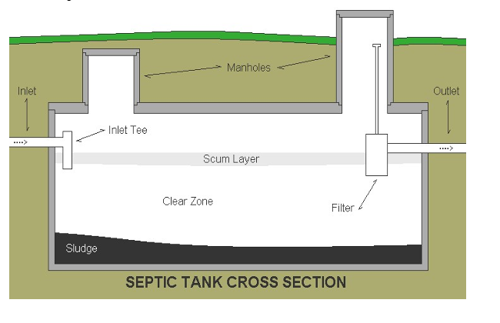
Whatever you put into your toilets, sinks or drains - flows into the septic tank. In the tank, most solids settle to the bottom and are partially decomposed by bacteria to form sludge. Some materials float and form a scum on top of the water.
The liquid in the tank (carrying bacteria, viruses, compounds of nitrogen and other potentially harmful substances) is discharged into a soil absorption field. The soil is your last line of defense to prevent polluted water from entering lakes, streams and groundwater. The wastewater is partially purified by the filtering action of the soil and the ability of microorganisms in the soil to decompose any of the remaining contaminants. However, the soil cannot remove some household chemicals and cleaners from the wastewater. Care should be taken when using these products and their use limited.
POWTS Maintenance
The most critical part of POWTS management is the decisions you make about what to put into the system as noted later under "Household Hints."
The Septic Tank
The tank is the part of the system that requires regular maintenance. You must have the tank cleaned out regularly so that sludge and scum don't build up. If you do not clean your tank when needed, sludge or scum will clog the outlet pipe or move out into the soil absorption field. This will clog the field and lead to a premature, costly failure of the system.
How do you know when your septic tank needs to be pumped?
You can have a commercial septage servicing operator give you an idea of how often you should have the tank pumped. It depends on the size of your family, the volume of water you use, whether you use a garbage disposal and the capacity of the tank. Typically, most tanks are serviced every three years. In fact, most systems are required by law to be inspected or pumped on a three year interval. Many counties send out reminder cards notifying you that it is time to service your system.
You can make your own determination about the need for pumping by measuring the sludge and scum depth in the tank. If the total depth of sludge plus the scum is more than one-third of the total depth of the liquid in the tank, it's time to have the tank cleaned. For example, if the total liquid depth is 48 inches, the tank should be pumped if the sludge portion plus the scum portion is over 16 inches. Pump the tank immediately if the scum is more than 4 inches thick or appears to be escaping through the outlet. Measuring the sludge and scum on your own can be difficult. It is recommended that you contact a septage servicing operator, POWTS maintainer or plumber to do it for you.
NOTE: The gasses generated in a septic tank are dangerous and can kill. Never enter a septic tank. Only a trained person with life support equipment and a trained assistant should ever enter a septic tank.
The Septic Tank Filter
Inside most septic tanks or pump chamber (nearly all since 07/00) is an effluent filter. The filter is designed to keep solids and other particles larger than 1/8 inch from escaping the septic tank and entering your drainfield.
Periodic servicing of the filter is required to maintain the effectiveness of the filter and assure proper operation of the system. Most filters must be serviced at least annually. Others, more frequently depending on manufacturers requirements and household use. Filters should be checked more often when first starting a new system to determine an appropriate service frequency.
In some instances, a homeowner may service their own filter, in others, it may require the services of a POWTS Maintainer. Check with your servicer or plumber to find out if you can clean your own filter and how to do it.
The Drainfield
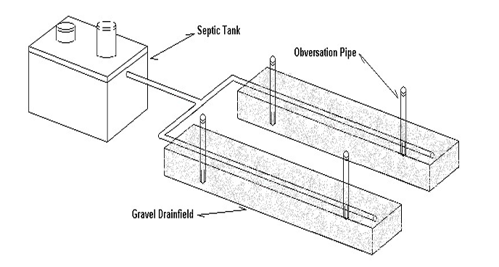
The area where the septic tank liquid infiltrates the ground may be called the soil absorption field, seepage cell, mound, dry well or more commonly, the drainfield. When properly installed and used, it will treat and disperse septic tank wastewater for many years. The soil absorption field requires little maintenance and should last many years if a few simple precautions are followed:
Minimize your water use and limit peak flows (i.e. do laundry over several days instead of one) so that you do not overload the drainfield.
Be sure your septic tank is maintained and working properly. Never allow sludge or scum to escape from the tank.
Some systems are equipped with a pump or dosing chamber that floods the absorption field in controlled doses rather than letting effluent continuously trickle from the tank. Make sure that all pumps or siphons are operating properly. Your plumber can give you advice on how to check your system.
Avoid compacting the soil in and around your drainfield that acts as a filter for wastewater leaving the tank. Keep buildings, vehicles & other heavy equipment, and animals off the absorption field.
Avoid overloading the absorption field with rainfall and snowmelt. Slope the land above the drainfield so surface water is not directed toward it and slope the land below it so water does not pond behind it. Make sure the downspouts from your house or other buildings carry water away from the drainfield. Never pile winter snow on the drainfield.
Household Hints that Help
To minimize maintenance costs, protect your lake and groundwater and prolong the life of your system:
Do the Following
Limit the water entering your tank. Use water saving fixtures. Fix toilet float valves, leaks and dripping faucets. Spread clothes washing over the entire week.
Pump or inspect the tank at least every three years (more often if you use a garbage disposal) or as indicated by your servicer.
Divert surface water drainage away from the absorption field.
If you are buying a house with a septic system, ask the owner for the name of their servicer and their maintenance records. Have the system evaluated by a professional. You may want to have the soil tested for compliance with the state uniform plumbing code.
Do Not
Do not connect the basement sump pump, water softener or other "clean water" discharges to the septic tank.
Do not put materials down drains that will clog the septic tank (fats, grease, coffee grounds, paper towels, sanitary napkins, diapers, cigarette butts, etc.)
Do not put toxic substances in drains that might end up in the groundwater (old medications, cleaning fluids, oils, paints, disinfectants, pesticides, etc.)
Do not use chemicals to clean or “sweeten’ your system. They may interfere with the biological action in the tank, clog the drainfield by flushing sludge and scum into the drainfield or add toxic chemicals to the groundwater. “Starters” are not necessary for new tanks or after pumping existing tanks.
Plant water seeking plants near your drainfield.
Any questions please contact DSPSSBPowtsTech@wisconsin.gov