
POWTS Private Onsite Wastewater Treatment Systems Brochure
Top four ways to protect your septic system
Regularly inspect your system and pump your tank as necessary.
Conserve water.
High-efficiency toilets.
High efficiency showerheads.
Faucet aerators.
Do small loads of laundry at a time.
Don’t dispose of household hazardous wastes in sinks or toilets.
Care for your drainfield.
Questions?
Contact your local county zoning department or Wisconsin Department of Safety and Professional Services at DSPSSBPowtsTech@wisconsin.gov
Remember
Your septic system contains a living collection of organisms that digest and treat waste. – EPA 2012
Never Flush
Baby Wipes
Condoms
Cigarette butts
Cat litter
Dental floss
Diapers
Feminine hygiene products
Paper towels
Pharmaceuticals or antibiotics
Never Pour Down Sink
Antifreeze
Coffee grounds
Cooking grease or oil
Disinfectants
Fruit and vegetable peelings
Gasoline
Herbicides
Household chemicals
Pesticides
Paint or paint thinners
Solvents
Water softener brine
Components of your Onsite Wastewater Treatment System
Septic Tank
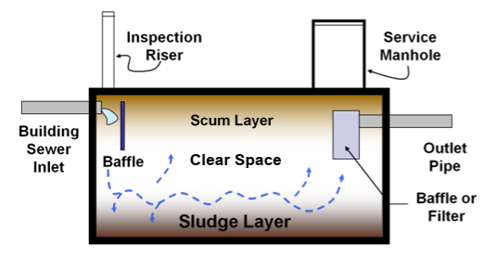
All household wastewater exits your home through a pipe to the septic tank. The watertight tank holds wastewater long enough to allow solids to settle out (sludge) while fats, oil, and grease float to the surface (scum).
Septic Tank Image Description
Building sewer inlet feeds into the septic tank, the bottom layer is labeled sludge layer, the middle area is labeled clear space, the top layer is labeled scum layer – there are dotted lines flowing through the septic tank representing the flow of matter in the tank which goes from the inlet to the outlet. There is a line inside the top left of the septic tank labeled baffle. On the top of the septic tank on the outside on the left side is a pipe labeled inspection riser and on the right top in a protrusion labeled service manhole – on the right side of the tank is an outlet pipe and the connected internally to a baffle or filter.
Concrete, coated steel, fiberglass, or plastic construction.
Required inspection or maintenance: usually once every 3 years.
Failure to perform maintenance will lead to sludge or scum buildup. This can lead to a clog in the septic tank or sludge and scum moving into the soil absorption field which leads to a system failure. This can only be fixed by clean up and system replacement.
Effluent Filter
Located inside of septic tank. Keeps solids and other particles larger than 1/8 inch diameter from entering the drainfield.
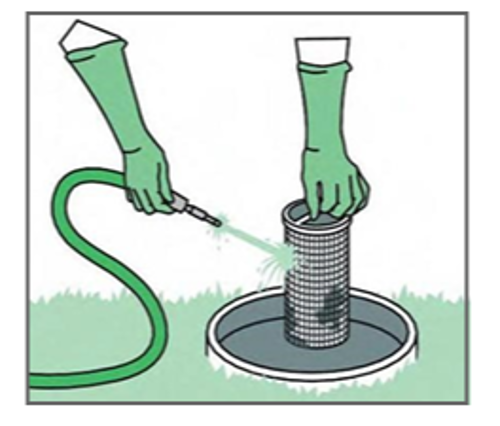
Require maintenance is performed as needed.
Kitchen Sinks – Do not overuse your garbage disposal
Toilet – Only human waste and toilet paper or tissue should be flushed
Drainfield (Soil Absorption Cell)
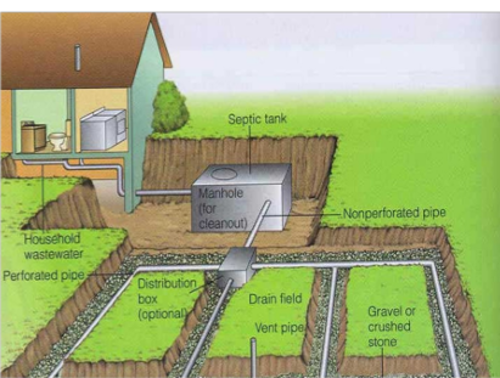
Removes contaminants from the liquid that emerges from the septic tank.
Drainfield Cross Section Image Description
A pipe flows out of house and feeds into the septic tank. The pipe is labeled household water. A septic tank in ground feeds out to a drain field. The top of the septic tank is labeled manhole for clean out. The pipe feeding out of the tank is labeled nonperforated pipe and feeds into a distribution box (optional) this then goes down into four parallel pipes in ground that are labeled perforated pipe. Below the pipes is gravel or crushed stone. At the end of the drainfield is a vent pipe.
Parking – Never park or drive on your drainfield
Planting – Plant trees the appropriate distance from your drainfield to keep roots from growing into your septic system. A septic service professional can advise you of the proper distance, depending on your septic tank and landscape.
Placing – Keep roof drains, sump pumps, and other rainwater drainage systems away from your drain-field area, as excess water slows down or stops the wastewater treatment process.