
Private Residence Inclined Elevators - Information for Homeowners
Introduction
Private residence inclined elevators are installed at single dwellings typically on hillsides along rivers and lakes. A condominium complex or other shared site is not a single dwelling therefore a private residence type inclined elevator may not be installed at such a location. From the adopted ASME A17.1 – 2016 Safety Code for Elevators and Escalators scope for
Section 5.4 Private Residence Inclined Elevators: Section 5.4 applies to inclined elevators installed in or at a (singular) private residence.
A condominium complex or other shared site would be required to use a commercial type inclined elevator.
Inclined elevators are sometimes called “trams”. They are sometimes called “inclined lifts” or “lifts” however this can cause confusion because an “inclined platform lift” is a different type of conveyance typically installed on a stairway inside a commercial building to serve persons in wheelchairs. Private residence inclined elevators are not to be confused with inclined platform lifts.
Companies that install private residence inclined elevators may have “Tram” or “Lift” in their name but whether a conveyance is a private residence inclined elevator depends only on the conveyance and not the model name or the name of the manufacturer or installer.

Regulated when serving a one-or two-family dwelling
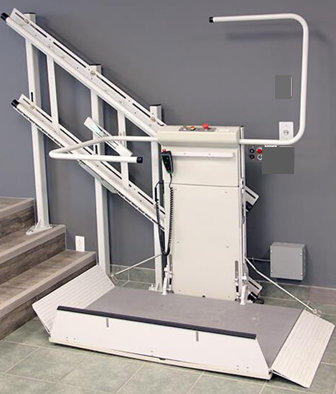
Not regulated when serving a one-or two-family dwelling
Applicable Wisconsin state statutes
101.981 – 101.988 Wis. state stat. Chapter 101
Applicable Wisconsin state codes
These codes are commonly referred to regarding elevators and other conveyances.
Adoption of National Standard
Most codes administered by the Department of Safety and Professional Services (DSPS) adopt a national standard. Currently, SPS 318 adopts the ASME A17.1 – 2016 / CSA B44 – 16, with Section 5.4 containing the requirements for private residence inclined elevators. [SPS 318.1005].
Similar requirements apply to private residence inclined elevators with a date of contract between the homeowner and installer on or after January 1, 2009.
New Installations
Planning: The first step in planning to install a private residence inclined elevator should be to contact the local municipality, lake district, river district and/or homeowners association where applicable and the Department of Natural Resources (DNR) regarding ordinances, rules or codes that may apply. These may limit changes to shorelines, hillsides and vegetation. A local building permit or electrical permit may also be required.
Most private residence inclined elevators have landing platforms and enclosures made of wood, composite materials or metal. Landings must be designed and constructed to meet precise clearance requirements to limit pinching or crushing hazards. Coordinate landing design and clearance requirements with the elevator contractor.
Licensing
The installation of a new conveyance may be performed only by a licensed elevator contractor [stat. 101.984(1)].
The homeowner must confirm with the elevator contractor or with DSPS that the elevator contractor has a current, valid elevator contractor’s license. utilizing only properly licensed personnel [SPS 305, Subchapter X].
The elevator contractor must utilize licensed elevator or lift mechanics, apprentices or helpers throughout construction [stat. 101.984(2].
Approvals
Conveyances are required to have product approval by DSPS and plan review and inspection by DSPS or the cities of Milwaukee or Madison as applicable. Approval of an installation by a building inspector, electrical inspector, lake or river district, homeowners association or DNR is not sufficient to begin construction or installation without also having the approval of the DSPS, Milwaukee or Madison elevator safety program.
Product Approval
Each model of inclined elevator must be certified by a recognized 3rd party test agency or a Wisconsin-licensed engineer or architect to confirm it will meet or exceed the minimum design and safety factor requirements of the adopted ASME A17.1 standard and SPS 318. The certification covers structural components such as suspension cables, drive machines, brakes, overspeed safety devices and car enclosures. For an elevator model that has not been previously certified, the elevator contractor should have the entire product certified and approved prior to marketing the product to a homeowner.
Plan Review
Plan review / approval is required before commencing the construction or installation of a conveyance [SPS 318.1007(1)(a)1 and Wisconsin state stat. 101.983(1)(a)]. Private residence inclined elevator plans are reviewed to confirm features that may be unique to each installation such as use of approved components, angle of inclination and platform size for the specified rated load. The plan reviewer will issue a conditional approval letter to the elevator contractor, owner and inspecting agency. The letter may include corrections needed to the plans and instructions to achieve compliance with safety codes necessary to pass the final inspection. The letter will identify the owner, site, conveyance and contact information for the plan reviewer and inspector.
One copy of the conditional approval letter and the approved plans must be on site from the beginning of the elevator contractor’s work until passing the final inspection of the conveyance. [SPS 318.1008(4)].
If the homeowner is aware of work beginning but has not received their copy of the conditional approval letter, it is in their best interest to contact their licensed elevator contractor and DSPS, Milwaukee or Madison as applicable.
Expiration of Plan Approval
An approval to install the elevator will expire under any of these circumstances:
The elevator contractor waits more than 6 months after approval before beginning the installation,
The elevator contractor begins the installation but work on the project is idle for more than 60 days or
2 years pass between the date of approval and completion of the final inspection [stat. 101.983(1)(d) and SPS 318.1008(2)(c)].
Inspection
When all installation work is complete including construction of the landings, the licensed elevator contractor must schedule the final inspection with the inspector or inspection agency indicated on the conditional approval letter.
The licensed elevator contractor must have a licensed elevator or lift mechanic present for the final inspection therefore the inspection is not scheduled by the homeowner. [SPS 318.1011].
The inspector shall provide the homeowner with a copy of the final passing acceptance inspection report to be kept in the owner’s maintenance records as proof of approval for use. An acceptance inspection fee shall be invoiced to the installing elevator contractor by the inspection agency [SPS 302].
Non-Compliance
The plan examination fee shall be doubled for projects where the installation, installation or construction was initiated without the required department approval [SPS 302.10]. Use of an elevator by the owner prior to passing the final inspection may result in a fine of up to $1500.00.
Permits to Operate and Ongoing Inspections
Throughout Ownership
There are no requirements for periodic inspections or renewal of permits to operate for elevators (and dumbwaiters) that only serve single dwellings.
The licensed elevator contractor shall provide the homeowner with a maintenance control program (MCP) detailing schedules for examination and maintenance of elevator components by the licensed elevator contractor [SPS 318.17086(2)]. For the safety of elevator passengers and proper operation of the equipment, an owner should follow the maintenance and service schedules provided in the MCP.
Upon Sale of the Property
If the owner and a prospective buyer of an individual residential dwelling unit that is served by a dumbwaiter or an elevator enter into a contract of sale for the unit that includes a provision requiring that the dumbwaiter or elevator be inspected, the inspection shall be performed by an elevator inspector licensed under stat. 101.985(3) [stat. 101.983(3)].
Older Existing Private Residence Inclined Elevators
Maintenance and Repairs
Wisconsin state statute defines conveyances to exclude residential conveyances that were installed with contract dates prior to January 1, 2009. Regulation of such elevators by SPS 318 is not required.
Replacement of Existing Elevators
Replacement of an elevator including the car or platform, drive machine and controller is considered a new installation and must meet the requirements described here for new installations.
Contract Disputes
If a dispute occurs between the owner of a residential elevator and an elevator contractor, a complaint maybe filed with DSPS at https://dsps.wi.gov/Pages/SelfService/FileAComplaint.aspx
or the Wisconsin Department of Agriculture, Trade and Consumer Protection at https://datcp.wi.gov/Pages/Programs_Services/ConsumerProtection.aspx